How insulated tumblers actually work, and what to look for

An insulated tumbler is one of the few everyday objects where the mechanism is genuinely simple and the differences between products are genuinely real. Understanding the mechanism makes the differences easy to spot on a listing.
The vacuum is doing the work
A double-walled tumbler has two steel shells with the air removed from the gap between them. Heat moves by conduction and convection, and both need a medium; a vacuum removes the medium, so the only remaining path is radiation, which is slow.
This is why a vacuum flask outperforms a thick-walled one so decisively. It is not about the amount of material, it is about the absence of it in the right place.
Double-walled is not the same as vacuum-insulated
Some products have two walls with ordinary air between them. That helps a little, because air is a poor conductor, but it is nothing like a vacuum. The word to look for on a listing is vacuum, not simply double-walled.
A quick physical test: a vacuum-insulated tumbler with a hot drink in it stays cool to the touch on the outside. One with air between the walls becomes noticeably warm.
The lid is where most heat escapes
The vacuum covers the sides and the base, and the opening does not have a vacuum across it. That makes the lid the weakest point by a large margin, and a sliding-aperture lid left open undoes much of the benefit.
A screw lid outperforms a push lid, and a push lid outperforms an open sipper. If a listing gives a hold-temperature figure, it is measured with the lid shut.
Hold-time claims are measured in ideal conditions
Manufacturer figures come from a full vessel, sealed, at room temperature and undisturbed. A half-full tumbler opened every ten minutes in a cold room will not come close, and that is not a defect.
Fill level matters more than people expect: the empty space holds air, and air carries heat away every time the lid comes off. A full tumbler genuinely does hold longer than a half one.
Preheating and prechilling actually works
Rinsing the tumbler with boiling water for thirty seconds before filling it, or with cold water and ice before a cold drink, removes the thermal mass of the steel from the equation. The gain is substantial for something that costs half a minute.
This is the single most effective thing you can do with an insulated vessel and almost nobody does it.
Stainless steel and taste
Food-grade stainless does not impart flavour, but it does hold onto residues if not washed properly, and coffee oils in particular build up into something that flavours everything afterwards. A tumbler that tastes of yesterday needs cleaning rather than replacing.
Bicarbonate of soda and hot water, left to stand, removes coffee residue that detergent does not. A bottle brush that reaches the base is worth owning.
What to avoid putting in one
Carbonated drinks build pressure in a sealed vessel, and dairy left for hours in a warm insulated container is a food-safety problem rather than a taste one. Neither is exotic advice and both are commonly ignored.
Nothing that has been sitting warm for a full day should be drunk on the strength of it still being warm. Insulation preserves temperature, not freshness.
Dishwashers, powder coats and printed finishes
The steel is dishwasher-safe. The exterior finish frequently is not: powder coats fade and printed designs lift after repeated hot cycles. Where a listing says hand wash, that is about the outside rather than the inside.
Lids and straws should come apart and be washed separately. The seal in a lid is where residue collects and it is the part most often skipped.
Dents, and why they matter here
A dent in an ordinary cup is cosmetic. A dent deep enough to breach the inner wall of a vacuum tumbler destroys the vacuum permanently, and the tumbler becomes an ordinary steel cup with no warning.
The symptom is a tumbler that suddenly stops holding temperature and gets warm on the outside. There is no repair for it.
Choosing between sizes and shapes
Check the base diameter against a car cup holder if it will live in a car, and check the height against the shelf in a bag. These two measurements cause more regret than capacity does.
Handles help for a tumbler that stays on a desk and get in the way for one that travels. Both are on our listings, along with capacity in ounces, because they are the specifications that decide the purchase.
Drinkware in stock
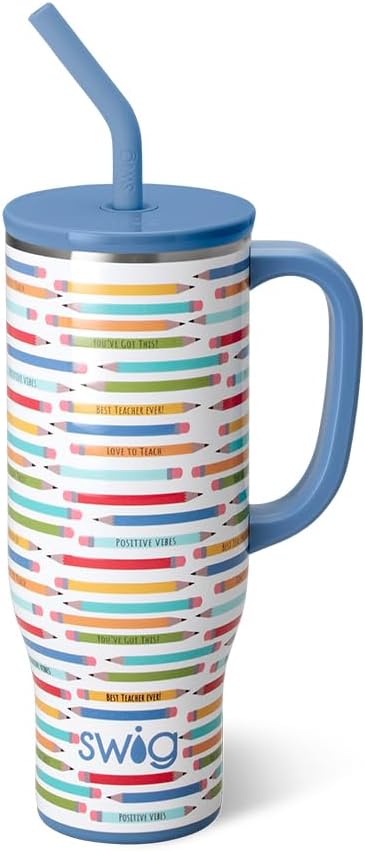
- Swig Life 30oz Insulated Mega Mug with Handle & Straw, Teacher Life — $44.95
- UAREHIBY 9-Piece Floral Teacher Appreciation Gift Set with 16oz Glass Cup — $19.99
- DOEARTE 20oz Thank Navy Blue Difference Maker Insulated Tumbler Gift — $18.99
- YXOTJHS Chaos Coordinator 20 oz Tumbler – Insulated Stainless Steel Coffee Mug — $17.99
What to check before buying
Look for the word vacuum rather than double-walled, treat the lid as the weak point, preheat or prechill before filling, keep it out of the dishwasher if the outside is coated, and never let it take a hard dent.
Questions about anything above? Our FAQ covers the usual ones, the Shipping Policy has the delivery detail, and you can contact us directly — we answer within one business day.